
San Marcos family law
San Marcos or Lake San Marcos? City, County and Your Case
Lake San Marcos lies outside San Marcos city limits, but California family law applies the same way in both. Your ZIP code, not city lines, decides the courthouse.
- California dissolution, custody and support
- Family lawCalifornia dissolution, custody and support
- Family cases filed in the North County Division
- San MarcosFamily cases filed in the North County Division
- Child support through the court or DCSS
- SupportChild support through the court or DCSS
- Confidential, private case handling
- DiscreetConfidential, private case handling
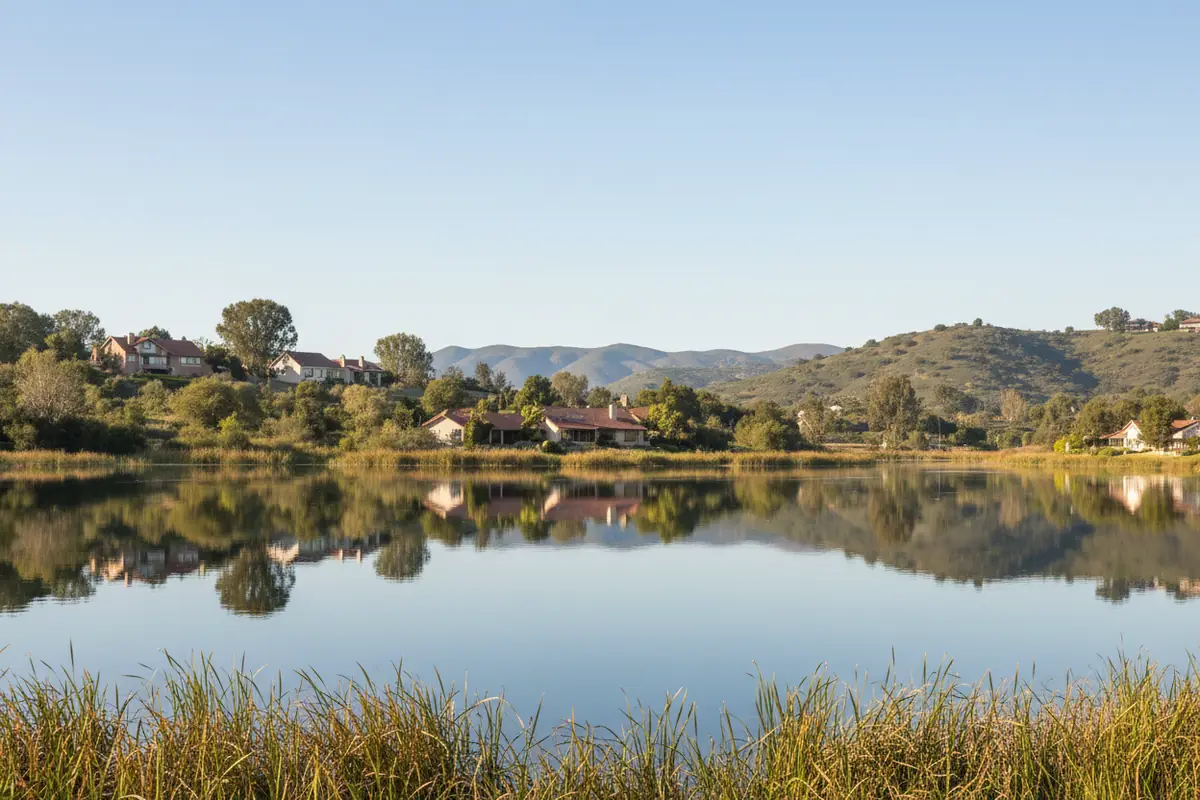
Whether your home is inside San Marcos city limits or in unincorporated Lake San Marcos, the same California Family Code governs your divorce, custody or support case. What sets the courthouse is your ZIP code: every San Marcos ZIP code files in the North County Division in Vista, while DCSS cases go to Central.
Most people facing a separation in Lake San Marcos arrive at this question sideways. A mailing address says "San Marcos," a tax bill or a deputy's patrol car says "County of San Diego," and somewhere in the middle of a marriage ending, a parenting schedule to work out, or a house by the lake to think about, it becomes unclear which government, which court and which rules apply. That uncertainty is reasonable, and it has a clear answer. This page walks through the city-versus-community line, the courthouse that hears San Marcos family cases, and the California rules that apply the same way on both sides of that line.
San Marcos the City and Lake San Marcos the Community
The City of San Marcos was incorporated on January 28, 1963, and became a charter city on July 4, 1994, according to the City of San Marcos. The city explains that a charter is a legal document approved by voters that lets a city create its own laws over certain matters, giving San Marcos more control over local affairs. According to the City of San Marcos, an elected City Council sets the big picture priorities and appoints a City Manager who oversees the city's day to day operations, a structure called the Council-Manager form of government.
Lake San Marcos is different. The U.S. Census Bureau treats it as a Census Designated Place, or CDP. In the Bureau's words, CDPs are "the statistical counterparts of incorporated places" that "are not legally incorporated under the laws of the state in which they are located." The Bureau also says CDPs "may not extend into an incorporated place." Because Lake San Marcos is a CDP, it lies outside the City of San Marcos. It has a name and a boundary for counting purposes, but no city government of its own.
Law enforcement shows how the two connect day to day. The San Diego County Sheriff's Office says that since its incorporation in 1963, the City of San Marcos has contracted law enforcement services with the Sheriff. Its San Marcos Station, at 182 Santar Place, San Marcos, CA 92069, serves the citizens and visitors of San Marcos and the surrounding unincorporated communities of Lake San Marcos, Elfin Forest, Harmony Grove, Hidden Meadows, Ivy Del, Del Dios, Lake Hodges and the San Pasqual Valley. So a household in Lake San Marcos and one inside the city are served by the same station, even though only one of them sits within city limits. The San Marcos Station page also notes that the station's Traffic Division enforces traffic and vehicle codes within the City of San Marcos, while the California Highway Patrol is responsible for traffic enforcement in unincorporated areas.
None of this changes a family law case. City status affects things like local ordinances and who runs city services. It does not create a separate family law, a separate family court, or a separate set of support or property rules for Lake San Marcos residents.
Which Courthouse Handles San Marcos Family Cases
The Superior Court of California, County of San Diego assigns family cases to a division by ZIP code, using its ZIP Code List (form ADM-254). That list assigns all four San Marcos ZIP codes to the North County Division:
- 92069 — San Marcos — North
- 92078 — San Marcos — North
- 92079 — San Marcos (post office box) — North
- 92096 — San Marcos (CSUSM) — North
The court marks 92096 with an asterisk, which it explains "indicates the zip code is for a specific company or organization," here California State University San Marcos. A student or campus-connected parent using that ZIP code files in the same division as everyone else in San Marcos.
Family cases in the North County Division are heard at the Superior Court of California, County of San Diego, North County Regional Center, 325 South Melrose Drive, Vista, CA 92081. Because the court sorts cases by ZIP code rather than by city boundary, a Lake San Marcos household finds its division by looking up the ZIP code of the address on the ADM-254 list. Where that ZIP code is one of the San Marcos codes above, the case belongs at the North County Regional Center in Vista.
One route works differently. Cases brought through the Department of Child Support Services (DCSS) are filed in the Central Division, at the Superior Court of California, County of San Diego, Central Courthouse, 1100 Union Street, San Diego, CA 92101. A San Marcos parent may have a divorce in Vista and, separately, a DCSS child support case at the Central Courthouse in San Diego.
California Family Law: The Rules That Govern Your Case
California's Family Code applies statewide. A spouse in a Lake San Marcos condominium and a spouse in a San Marcos city apartment face the same rules, read by the same court.
The six-month waiting period. Under Family Code section 2339, a judgment of dissolution does not end the marriage until six months have passed from the date the summons and petition are served or the date the respondent (the spouse who did not file) appears in the case, whichever occurs first. The clock does not start on the filing date, and the court may extend the period for good cause.
The preliminary declaration of disclosure. This is a sworn statement, on a Judicial Council form, listing every asset and debt a spouse has or may have, together with an income and expense declaration and all tax returns the spouse filed in the two years before serving it. Under Family Code section 2104(f), the petitioner serves it with the petition or within 60 days of filing the petition, and the respondent serves it with the response or within 60 days of filing the response. The spouses can extend those periods by written agreement, or the court can extend them by order.
Equal division of community property. Community property is, in general terms, what a married couple acquired during the marriage. Family Code section 2550 directs the court to divide the community estate equally, unless the spouses agree otherwise in writing or on the record in court. Under Family Code section 2552, the court values those assets and debts as near as practicable to the time of trial. On 30 days' notice and for good cause, it may value some or all of them at a date after separation and before trial.
Separate money put into community property. Separate property is generally what a spouse owned before the marriage or received by gift or inheritance. Under Family Code section 2640, a spouse who traces a contribution, such as a down payment, improvements, or loan principal, to a separate-property source is generally reimbursed for it when community property is divided, without interest and capped at the property's net value, unless that right was waived in writing. The opposite situation, where community money pays down the loan on one spouse's separate-property home, is handled by a different approach courts call Moore/Marsden apportionment.
Summary dissolution. California offers a simplified divorce for some shorter marriages with limited property and debt. Its dollar limits are set by statute and adjusted periodically, so the current figures should be checked at the time of filing.
Custody, Visitation, and the Court's Mediation Process
For a parent in San Marcos or Lake San Marcos, this part of a case often carries the most weight, because it shapes where the children wake up on a school morning. The procedure starts with a firm rule. Under Family Code section 3170, when a petition or other request shows that custody, visitation, or both are contested, the court must set the contested issues for mediation. In a contested custody case, that step is required.
In San Diego County, that mediation is child custody recommending counseling with the court's Family Court Services. Under Family Code section 3183(a), and except as section 3188 provides, the mediator, called a child custody recommending counselor, may, consistent with local court rules, submit a recommendation to the court about custody or visitation, if the counselor first provides it in writing to the parties and their attorneys, including counsel for any minor children, before the hearing. The court must ask at the hearing whether the parties received it. Family Court Services calls this person the Family Court Counselor.
According to Family Court Services, if the parents do not reach agreement, the Family Court Counselor makes a recommendation to the court and the court hearing proceeds. That recommendation can carry real weight, though the judge makes the decision. Section 3183 also allows the counselor to recommend an investigation or other services before the hearing, and, in appropriate cases, restraining orders to protect the child while the dispute is pending.
Where domestic violence is part of the picture, section 3170(b) says those cases are handled by Family Court Services under a separate written protocol approved by the Judicial Council.
Support, Property, and Other Issues the Court Resolves
Money questions often feel most pressing in the weeks after a separation, when one household becomes two. The court has a defined set of tools for them.
Child support is calculated under California's statewide guideline formula, which applies the same way to a San Marcos family filing at the North County Regional Center as to one with a DCSS case at the Central Courthouse.
Spousal support may be ordered while the case is pending and at judgment. In setting support at judgment, Family Code section 4320 directs the court to consider a list of circumstances, including each spouse's earning capacity and marketable skills, contributions to the other's education or career, ability to pay, needs based on the marital standard of living, assets and debts, the length of the marriage, the effect of work on dependent children, age and health, documented domestic violence, tax consequences, the balance of hardships, and the goal that the supported spouse become self-supporting within a reasonable time. For marriages that are not of long duration, that time is generally half the length of the marriage, though the court keeps discretion to order more or less.
Attorney fees. Family Code section 2030 requires the court to ensure each party has access to legal representation, including early in the case. When a request is made, the court decides whether there is a disparity in access to funds and whether one party can pay for both. If the findings show that disparity and ability to pay, the court orders fees and costs. Fee and expert costs vary widely with the issues, so no range applies across cases.
A family business. A business's value can include goodwill, and its value is decided on the evidence, often with experts.
Self-Help and Court Resources for San Marcos Residents
The Superior Court of California, County of San Diego runs a Family Law Facilitator program and posts self-help resources on its website at sdcourt.ca.gov. For a San Marcos or Lake San Marcos household whose case falls in the North County Division, the court location is the North County Regional Center, 325 South Melrose Drive, Vista, CA 92081. Hours and locations for the Facilitator are best confirmed on the court's own pages before a visit.
Anyone considering a lawyer can check that lawyer's license, and any certification from the State Bar's Board of Legal Specialization, through the State Bar of California's public attorney search. San Marcos Family Law Advocates practices California family law only.
If You'd Like to Talk Through a San Marcos or Lake San Marcos Case
The city line around San Marcos rarely changes the law, but the details of a particular case still do: whether a home was bought before the marriage, whether separate money went into it, whether custody is agreed or contested, and whether child support runs through DCSS or the divorce itself. A consultation is a place to sort which of these apply and which court and rules will govern them. To talk through how this applies to your situation, contact San Marcos Family Law Advocates to request a confidential consultation.
Frequently asked questions
Is Lake San Marcos part of the City of San Marcos?
Where is a family law case filed if I live in Lake San Marcos?
Does California's community property law apply differently in unincorporated areas?
Is mediation required in a San Diego County custody case?
How long does a divorce take in California?
What is the preliminary declaration of disclosure?
Can the court order one spouse to pay the other's attorney fees?
Attorney Contributor: Amy J. Lass | California Bar No. 246779
Amy J. Lass contributes legal expertise and reviews selected legal content for accuracy. General information only — not legal advice.
- Published
- November 7, 2026
Sources
- ADM-254 Zip Code List, Superior Court of California, County of San Diego — Superior Court of California, County of San Diego
- Your Government, City of San Marcos — san-marcos.net
- San Marcos Station, San Diego County Sheriff's Office — sdsheriff.gov
- Geography Program Glossary, U.S. Census Bureau — census.gov
- Cal. Fam. Code § 2339 — California Legislative Information
- Cal. Fam. Code § 2104 — California Legislative Information
- Cal. Fam. Code § 2550 — California Legislative Information
- Cal. Fam. Code § 2552 — California Legislative Information
- Cal. Fam. Code § 2640 — California Legislative Information
- Cal. Fam. Code § 2030 — California Legislative Information
- Cal. Fam. Code § 3170 — California Legislative Information
- Cal. Fam. Code § 3183 — California Legislative Information
- Cal. Fam. Code § 4320 — California Legislative Information
Questions About Your Case?
Divorce and custody questions rarely fit neatly into an article. Send us a message, and we'll listen to what's going on and help you understand your next steps.